Diagram of a geothermal system with pumps and auxiliary components on a white background

Version 2.4 — Geocooling and DHW Production

The latest release adds full support for geocooling and domestic hot water production, simulated over horizons from 1 to 50 years.

  • Free demo version available for immediate download
  • Free license for university teaching and academic research
  • A typical closed-loop geothermal heat exchanger, also know as ground heat exchanger or geoexchanger.

    Borehole Field Design

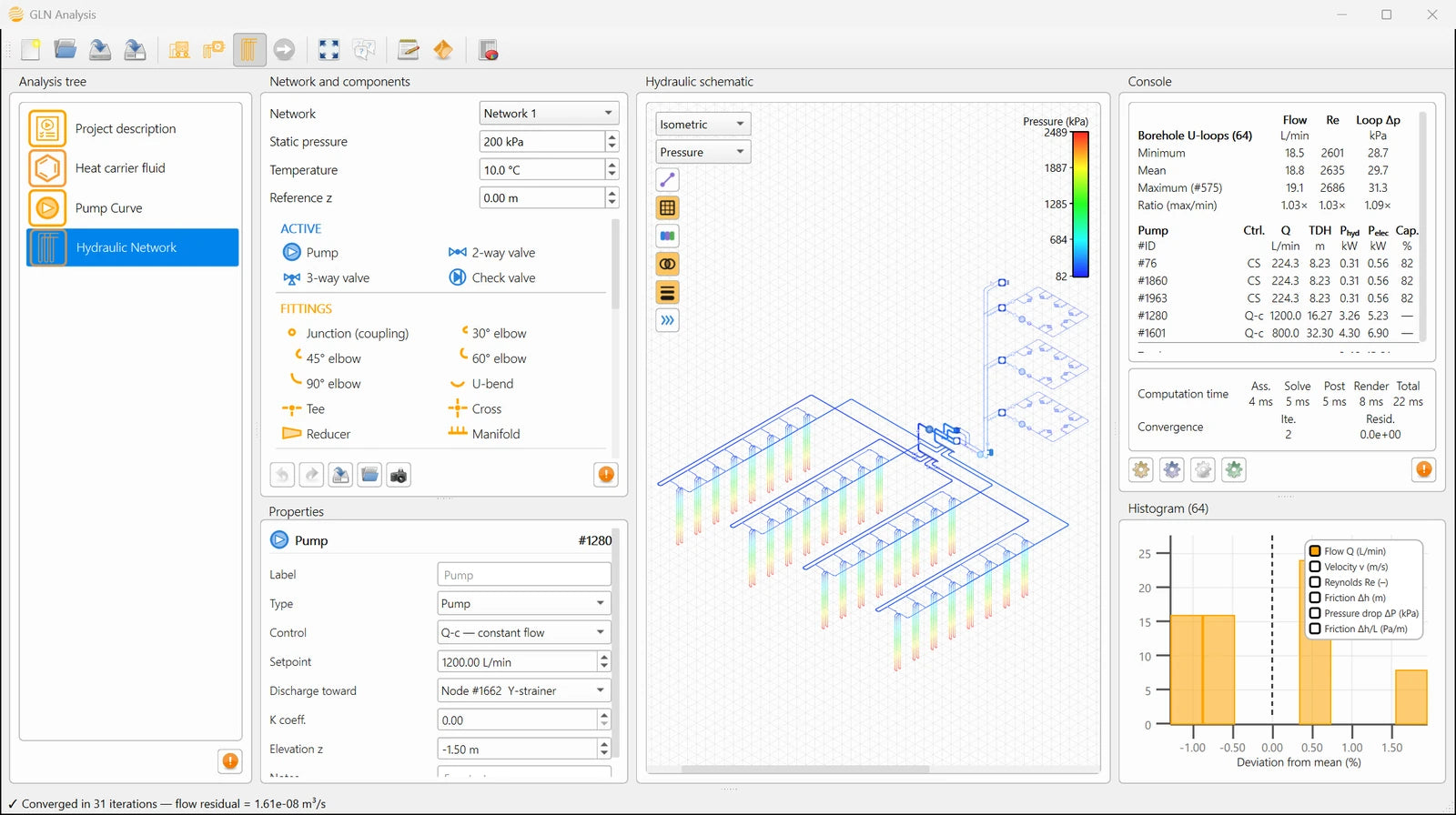
    Interactively model complex ground heat exchanger layouts, including groundwater flow and inclined boreholes

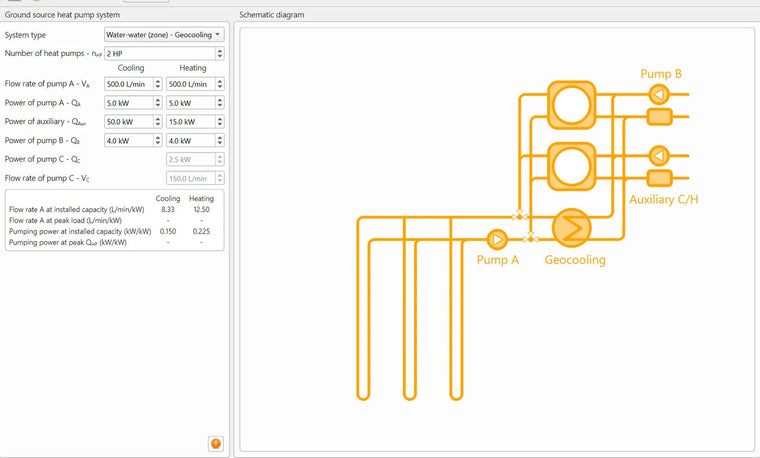
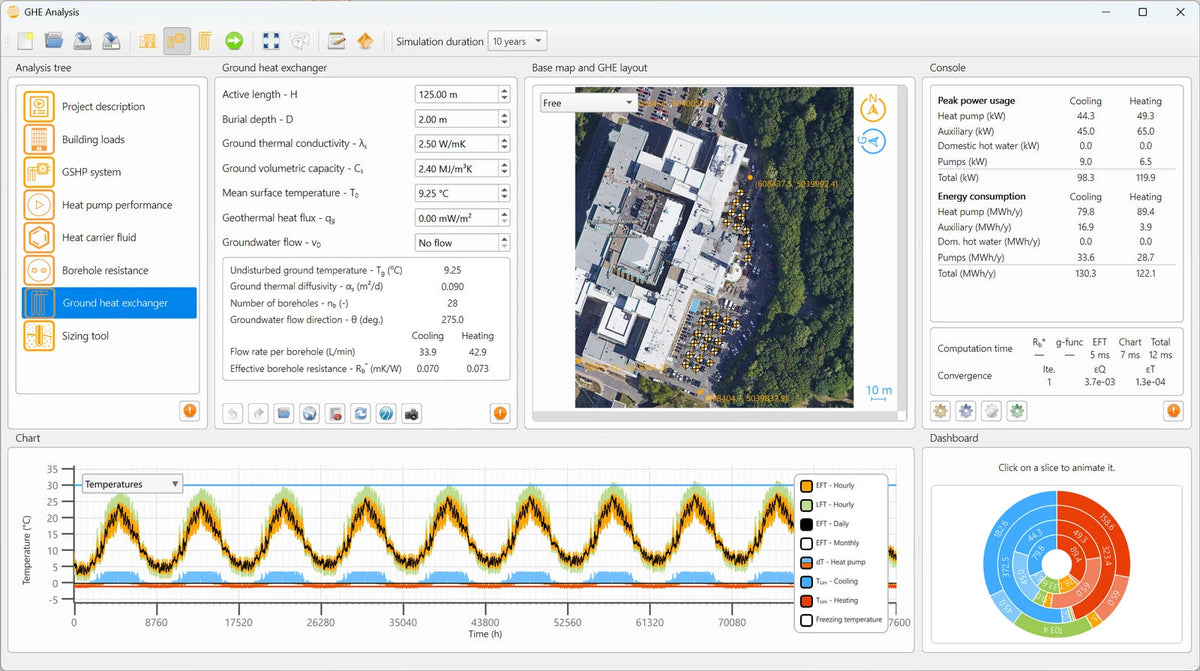
  • A typical ground-source heat pump (GSHP) system composed of boreholes and a heat pump. The GHE Analysis software program enables hourly simulation of system responses and quick ground heat exchanger sizing.

    GSHP System Simulation

    Hourly simulation of hybrid geothermal systems — optimize seasonal COP over multi-year horizons

  • Designing a GSHP system requires determining the total length of the geothermal boreholes. The GHE Analysis software provides a sizing tool that uses the alternative ASHRAE method.

    GHE Sizing (ASHRAE)

    Size ground heat exchangers using the ASHRAE alternative method and identify the parameters driving borehole length

  • The thermal loads of a building influence the design and sizing of a GHE. GHE Analysis software incorporates the building's hourly energy demand into its simulations.

    Building Loads Analysis

    Analyze hourly or monthly building heating and cooling loads, and assess heat pump coverage and peak demand

  • A typical single U-loop borehole heat exchanger (BHE) composed of 2 pipes embedded in grout. The design of the BHE impact its thermal efficiency, which can be compared easily with GHE Analysis.

    Borehole Heat Exchanger

    Compare single U-loop, double U-loop, coaxial, and standing column well configurations to select the most efficient BHE

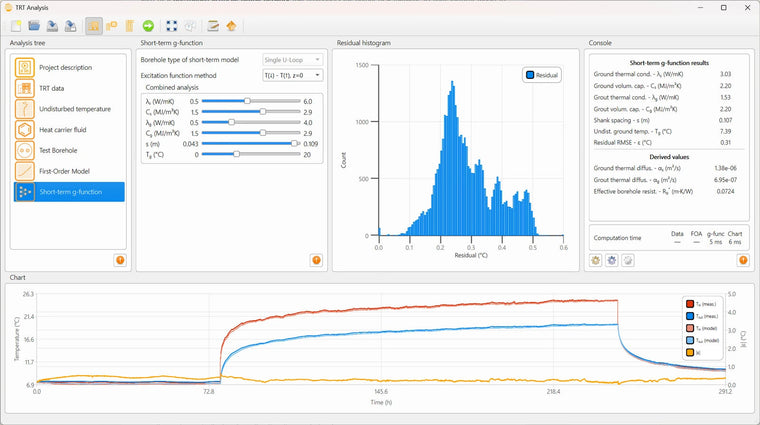
  • Temperature measured during a thermal response test (TRT) and used in the test analysis.

    TRT Interpretation

    Interactively interpret thermal response test data using the infinite line source model and an ANN-based approach

  • Thermal response unit connected to a geothermal well used to determine local ground properties.

    Interrupted TRT Analysis

    Analyze interrupted TRTs and account for variations in heating power using a neural network trained on 3D FEM data

  • A typical ground-source heat pump (GSHP), also known as geothermal heat pump, can provide energy savings due to its high coefficient of performance (COP).

    Heat Pump Performance

    Use temperature-dependent COP and capacity curves to accurately model part-load efficiency and energy costs

    See all features 
1 of 8
A typical ground-source heat pump (GSHP) system composed of boreholes and a heat pump. The GHE Analysis software program enables hourly simulation of system responses and quick ground heat exchanger sizing.

Design Ground-Source Heat Pump Systems with GHE Analysis

GHE Analysis is a professional software package for the design and simulation of ground-source heat pump systems. Use it to size irregular borehole fields, compute g-functions and borehole thermal resistance, and simulate the hourly entering fluid temperature over a multi-year horizon. Based on over two decades of academic research at Polytechnique Montréal, GHE Analysis integrates a rigorous, fast simulation engine that lets you visualize energy consumption, peak power demand, and operating costs — all from a single workflow.

View the full feature list →

Download Free Trial

GHE Analysis — Software Interface

Thermal response unit connected to a geothermal well used to determine local ground properties.

Interpret Thermal Response Tests with TRT Analysis

The design of any GSHP system starts with knowing the thermal conductivity of the ground. TRT Analysis interprets thermal response tests — including interrupted or variable-power tests — using both the infinite line source model and an artificial neural network trained on a transient 3D finite element model. It accounts for fluid, pipe, grout, and geological properties for maximum accuracy.

Try TRT Analysis for free

TRT Analysis — Software Interface

Frequently Asked Questions

What types of borehole heat exchangers does GHE Analysis support?

GHE Analysis supports single U-loop, double U-loop (adjacent and diagonal), coaxial borehole heat exchangers, inclined boreholes, and standing column wells up to 500 m deep. All configurations can be mixed in a single borehole field simulation.

How many boreholes can GHE Analysis simulate?

The standard version supports up to 625 boreholes in a single simulation, with a maximum depth of 500 m and a simulation period of up to 50 years. Extended capacity for fields of 625 to 3,000 boreholes is available on request.

Is a free trial available?

Yes. A fully functional demo version of GHE Analysis is available for free download. The demo lets you explore all features of the software before purchasing a license. No credit card is required.

What operating system is required?

GHE Analysis runs on Windows 10 and above (64-bit). macOS and Linux are not currently supported.

Is there a free license for academic use?

Yes. A free license is available for university teaching and non-commercial academic research. Please contact us with your institutional affiliation to request one.

How does the annual subscription work?

Each license is valid for one year from the purchase date. You will receive a license code by email immediately after purchase. Renewal is required annually to continue using the full version. You may request a refund within 30 days if you are not satisfied.

Start Designing Better Geothermal Systems Today

Download the free trial and explore all features — no commitment required. Annual professional license available at USD 335/year.